

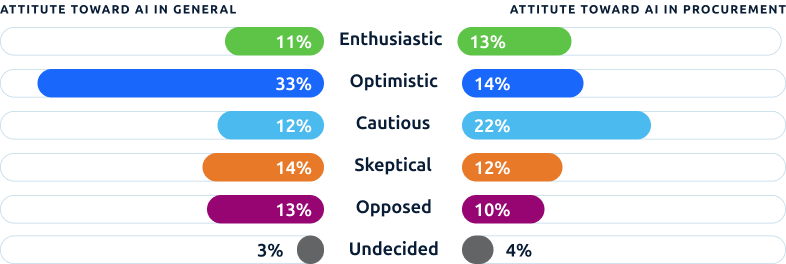
We asked survey respondents the same questions about AI in general, and in the context of procurement specifically. The responses revealed much more cautious approaches professionally than at home, demonstrating a need to proceed with communication and reassurance.
What is your overall attitude toward AI in general/public procurement?
There’s a common assumption in conversations about AI adoption that people are skeptical because they’re unfamiliar with the technology or generally resistant to change.
But the 2026 State of AI in Procurement survey found the skepticism is more nuanced than just a general unwillingness to learn new things.
We asked procurement professionals their overall attitudes about Artificial Intelligence in two contexts: first, in their public procurement work, and second, in daily life. The results showed a much more cautious approach professionally than in general.
In the general context, 45% said they are either enthusiastic or optimistic about AI. In the procurement context, that dropped to 36%. The cautious group nearly doubled, from 16% in general to 30% in procurement. Skeptical or completely opposed to AI? 36% in general and 30% in procurement, with 5% undecided in both contexts.
The shift doesn’t go fully from optimism to opposition, but it does reflect an overall feeling of caution when AI is applied to public procurement usage. Many more respondents went from confident about AI in everyday life to uncertain when the professional context entered the picture.
Why the Context Changes the Calculation
Procurement professionals who apply more caution to AI at work than in their personal lives aren’t inconsistent or hypocritical. They’re discerning and calculating. Public procurement is governed by statute, subject to vendor protest, open to public records requests, and accountable to the public in ways that most personal or private sector contexts are not.
An AI error in a solicitation scope or an evaluation calculation is more than just an embarrassing inconvenience to be corrected. It’s a potential legal challenge that brings public accountability into question and sets your agency up for reputational and financial risk.
Even if you use AI tools at home to draft an email, summarize a document, or design a poster for an event, it’s entirely rational to apply higher scrutiny to using AI in a professional workflow – or to avoid it altogether. The additional caution reflects a professional judgment against a different set of stakes, not technophobia or refusal to adapt.
Internal Conversations Determine Comfortability
The survey also found that in most agencies, the internal conversation about AI hasn’t progressed very far, leading procurement professionals to feel uneasy about how secure and accurate AI tools can be in their workflows.
We heard from 15% of respondents that their team has not discussed AI enough for them to gauge where colleagues stand. Another 18% were more enthusiastic than their colleagues, while 16% were more cautious. Even in within teams and departments, there are various sentiments about AI that still need to be worked through.
When asked who in their organization would be the biggest source of resistance to AI adoption, most respondents (29%) didn’t know. Senior leadership and risk aversion was the second highest at 16%, and legal compliance concerns ranked third at 15%. Procurement staff themselves were deemed the least resistant, at 6%.
The practical implication here is that the procurement team isn’t the one that needs to be convinced about AI’s use and benefits. The case still needs to be built around leadership, legal, and compliance. And their concerns are specific and different from the efficiency arguments that tend to dominate the AI conversation.
Framing the Internal Conversation
The data suggests a few ways to go about building this trust. First, frame the question about AI around readiness, not adoption. Ask whether your agency is prepared to evaluate AI responsibly, not to fully implement it, to earn broader early support. It positions the conversation as preparation rather than commitment.
Second, address auditability directly with legal and compliance. Their concern isn’t abstract. They need to know whether AI-assisted data and decisions can be documented, explained, and defended in a formal setting. Give them a concrete answer, even a preliminary one, to move the conversation further than a general argument about AI’s potential.
Third, senior leadership and elected officials typically name public perception as a barrier to AI adoption. Acknowledge this concern as a legitimate factor and discuss ways to positively frame AI adoption to constituents and vendors, especially for agencies with high public visibility.
The reduction in confidence in AI from general to professional contexts demonstrates that procurement professionals understand their environment and the risks associated with it. Don’t focus your internal adoption efforts on reducing caution altogether. Instead, channel that caution into a policy framework, an evaluation process, and an implementation approach that reflects the public sector accountability standards public procurement has always held.
The full 2026 State of AI in Procurement Report covers the survey’s attitude and change management findings in depth, including what the data shows about internal resistance and how to address it. Download it now to get the full picture. Get the report now.
SHARE


