

Much of the conversation around Artificial Intelligence in public procurement right now centers around potential: What AI might be able to do or how it could possibly be used?
But our AI in Procurement survey asked procurement professionals a narrower question.
“If your agency already uses or has piloted AI, what are you doing with it, and what are you seeing?”
Of our 150+ total respondents, 41 said their agency used or has piloted AI in procurement. Of those, 22 have deployed dedicated AI tools, 12 use AI features built into platforms they already use, and 7 have run a pilot program.
Further, 38 gave a specific answer about where they use AI and what results they see. Because the group is a small portion of our larger survey field, use these figures as directional, not definitive.
Where It’s Being Used
Respondents could name one primary function. Of the 38 who did, 19 chose drafting solicitations or RFPs (13) or drafting and editing documents (6). Nine chose “other,” and several of those described using AI across multiple functions, including research, document review, and compliance monitoring. Only a few named bid evaluation and scoring, spend analysis, or contract review.
Since the question allowed only one answer, these figures may understate how many tasks each agency uses AI for, but the pattern still tells us that early use is focused on drafting and document work, where staff members can review outputs before they go anywhere.
What Results THEY'VE Seen
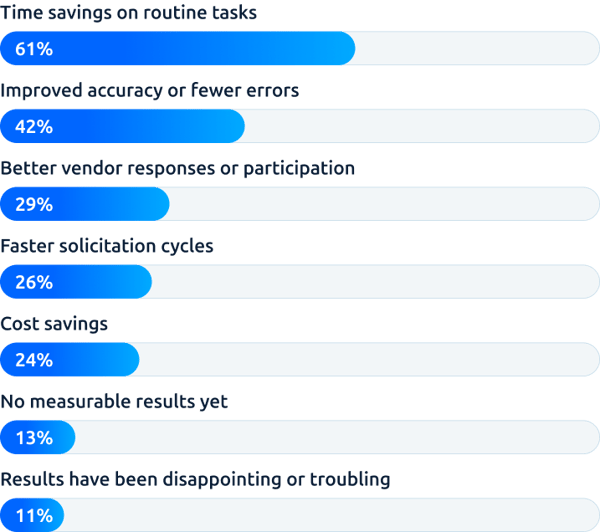
When asked about results, those 38 respondents could select more than one answer:
We also asked anyone using AI in procurement to name the single biggest benefit. Of the 59 respondents who chose a listed benefit, 27% said summarizing large amounts of data in seconds and 25% said saving time on administrative tasks. Not every response was positive, however. One wrote that they “still have to check everything.”
What This Means for Your Agency
Start where review is easy. Drafting and document editing tasks produce outputs a person can read, correct, and approve. That makes them simpler to record and defend than AI-assisted scoring or award recommendations.
Decide how you will measure results before you begin. Those who reported time savings can say what they were measuring, while those with no measurable results may not have set a baseline.
Keep human review in place. Reviewing every output keeps your AI usage accountable.
Get the Full Report
The full 2026 State of AI in Procurement Report includes the capabilities respondents most want and a guide to designing a limited pilot.
SHARE


