

It’s a familiar story. You purchase a new technology platform, go through the implementation process, hold kickoff meetings and train your staff. The staff is antsy but optimistic. A few early projects go through the system, and then, months later, you’re back to the manual processes you were trying to replace.
Sound familiar?
It happens all the time in procurement. Teams go back to their spreadsheets. Emails start replacing workflows. Leaders start to wonder why the system isn’t being used the way it was supposed to be and why the money was spent in the first place.
The truth is that most failed implementations aren’t about the software itself. Adoption fails because it was treated as a box to check instead of a core part of a continuing strategy.
Why Adoption Fails
When you dig into failed or stalled implementations, the patterns are easy to spot:
- Teams were trained once, then left to figure things out
- Approvals and processes weren’t clearly mapped before go-live
- The system didn’t match how people actually work
- Staff didn’t understand how the new system would help them
- Continued training and customization were costly or unavailable
You got the technology but not the buy-in. It’s not resistance to change. It’s human behavior to revert to the easiest way.
Modernization isn’t about just buying software. Truly modern processes help people work in a new way by removing friction and making the correct process the simplest one to follow.
Adoption Starts with Stakeholders, Not Software
One of the biggest mistakes agencies make is launching a new system without engaging the people who will use it every day. When frontline staff are left out of planning, they’re far less likely to trust and adopt the new process and far more likely to continue doing things “the regular way.”
Extra handoffs, unclear roles, verbal approvals, inconsistent document storage all seem inefficient, but they’re familiar. And familiar is easy to fall back on.
Effective adoption means involving end users early by listening to pain points, mapping existing workflows and bottlenecks, and ensuring the new system aligns with how they really work.
What makes adoption stick?
- Clear roles: so everyone knows what they’re responsible for and tasks don’t bounce around
- Fewer handoffs: to reduce delays and errors and improve tracking
- Built-in governance: so approvals and records live inside the system
- Visibility: so teams can see where work is slowing down and how to improve
With these in place, people won’t need to be reminded to use the system. It will just become the fastest, most logical way to work.
Training Should Be Ongoing and Practical
If you’ve ever experienced one of those rushed, all-in-one staff training meetings where someone clicks quickly through every tab in a system, you know it’s not effective. It overwhelm sand irritate users and makes them more resistant to adoption.
Successful training is short, practical, and hands-on. It should show how the system handles your actual work and common problems. Ideally, it happens right before people need to use the system, or even as they’re beginning to use it.
Agencies that do this well often appoint internal “power users” who help others learn the system and navigate new workflows. These peer advocates can answer questions, gather feedback, and reinforce habits, without overloading IT or procurement leads.
Make the System Work for the People Using It
Adoption improves drastically when the system feels intuitive and reduces real effort. Features like pre-built templates, easy uploading, automated workflows, and one-click approvals can go make a big difference.
The system should also be flexible enough to reflect how different departments and teams operate, while still enforcing consistency across the organization. The key is balancing structure and adaptability.
If staff must work around the system to get things done, rather than relying on the system to create the correct processes, that’s a clear sign that your implementation needs work.
Measurement Reinforces Change
In wellness culture, they say it takes 21 days to create a habit and 90 days to make a lifestyle change. Technology adoption works the same. Enforced use is important, but so is support and visible progress.
Track simple, meaningful metrics, like time from purchase request to solicitation release, time spent responding to vendor emails and phone calls, hours spent chasing approvals or even historical pricing data.
Don’t just track system usage. Measure improvement, time saved, clicks reduced, and bottlenecks removed to build momentum and demonstrate success.
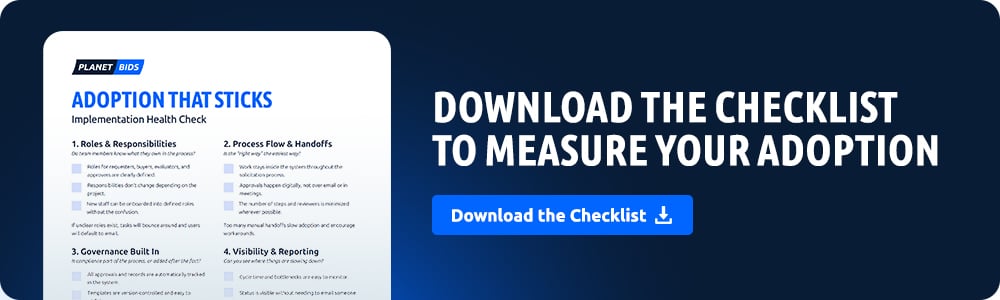
A Quick Adoption Check
If you’re not sure where adoption stands today, ask yourself these four questions:
- Do roles and responsibilities change depending on the project, or are they clear every time?
- How many times does work leave the system before a solicitation is published?
- Are approvals and records captured automatically or recreated later for audits?
- Can you quickly see where bottlenecks and cycle time issues are occurring?
If any of these are hard to answer, adoption – not technology – may be the problem.
Adoption Is the Project
The most successful procurement teams understand that adoption isn’t a side task. It is the main project. A tool that no one uses won’t improve compliance, reduce cycle time, or help finance teams manage reporting.
Digital procurement platforms like PlanetBids’ end-to-end system can do all those things, but only when the people behind them are supported through the change. That means having time to get used to new processes and the space to ask questions or suggest adjustments.
The strongest procurement teams treat adoption as a design challenge, not a behavior problem. They ask simple, but important, questions:
- Is it easier to follow the process than to work around it?
- Does the system reduce effort or add steps to my process?
- Can leaders see what’s happening and get info without asking for updates?
Not sure where to start?
We break down how to spot and reduce the problem areas that cause procurement teams headaches in our blog, “Reducing Bottlenecks in Procurement.”
Want to find a procurement system that actually supports your team, without costly customizations and long implementation timelines? Check out how PlanetBids can streamline end-to-end public procurement to help reduce cycle times, expand your vendor network, and maintain transparent compliance. Learn more.
SHARE


