
Your procurement documents are some of the most important and most difficult documents your agency produces.
They need to be clear enough for vendors to understand, detailed enough to meet compliance requirements, and consistent enough to hold up under protest.
That’s a lot to balance for a public procurement agency that’s likely understaffed, under-budgeted, and under water.
It’s even worse when those documents are created from scratch with every new purchase or solicitation.
The Reality of Writing Procurement Documents
Of course, most solicitations don’t literally start “from scratch.”
They start from past bids, saved templates, copied language, internal notes, and desktop drafts. You have to search through all of your saved folders, shared drives, or paper files to find the right document that you just know has the language you want to copy.
Once you find that blurb or boilerplate, then you have to spend hours editing, adjusting, reviewing, and getting approval. This includes trying to make the language clear, ensure requirements are accurate and comprehensive, outdated terms are removed, and that everything aligns with current policies.
That’s careful, tedious work that takes valuable time from your already stacked schedule. And if you miss a line or a date? Even the smallest inconsistencies or inaccuracies can cause major problems like vendors misinterpreting requirements, increased questions submitted, more addenda released, and a higher likelihood of risk during evaluation or audit.
The stakes are high, which is why document creation often becomes the slowest part of the procurement process.
Repetition, Not Effort, Is the Real Problem
Your procurement team isn’t struggling to get out comprehensive documents because they don’t know how to write them.
More likely, they’re having a hard time because they’re doing the same work over and over again, rewriting similar scopes, cleaning up redundant language, and reformatting nearly identical sections.
The more repetitive the work, the greater chance for an honest, albeit careless, mistake to creep in and set you up for big risk.
But Artificial Intelligence can help smooth the process and speed up document creation and release by automating the repetition.
Added Value from AI
Workers in all industries, even public employees, are concerned about AI replacing their jobs. But AI’s best use isn’t in making you redundant, it’s in streamlining redundant work.
In document creation, AI is most useful when it acts like a strategist and editor, not as an author. It can easily help you clean up rough drafts, improve clarity and readability, standardize language across documents, and reduce duplication and inconsistencies in language.
For example, instead of getting specifications and scope back from your engineer and spending several hours rewriting the content for clarity, your buyers can refine the language quickly with AI, focusing on whether the content is correct, not whether it looks pretty.
Shifting your valuable time away from formatting and editing frees you up for decision making and strategy, so you can do the work AI can’t – and shouldn’t – do.
Consistency Over Speed
While AI can help speed up document preparation, that’s not the biggest benefit.
Consistency in language can help you answer fewer vendor questions, set clearer expectations, receive more comparable and accurate bid responses, and get more competitive pricing to save taxpayer funds.
It also strengthens compliance. It’s easier to demonstrate fair, transparent, and repeatable processes documents with documents that follow consistent structures and language patterns.
AI can support that consistency, especially when used within standardized templates and workflows.
AI Should Work Inside Your Document Management
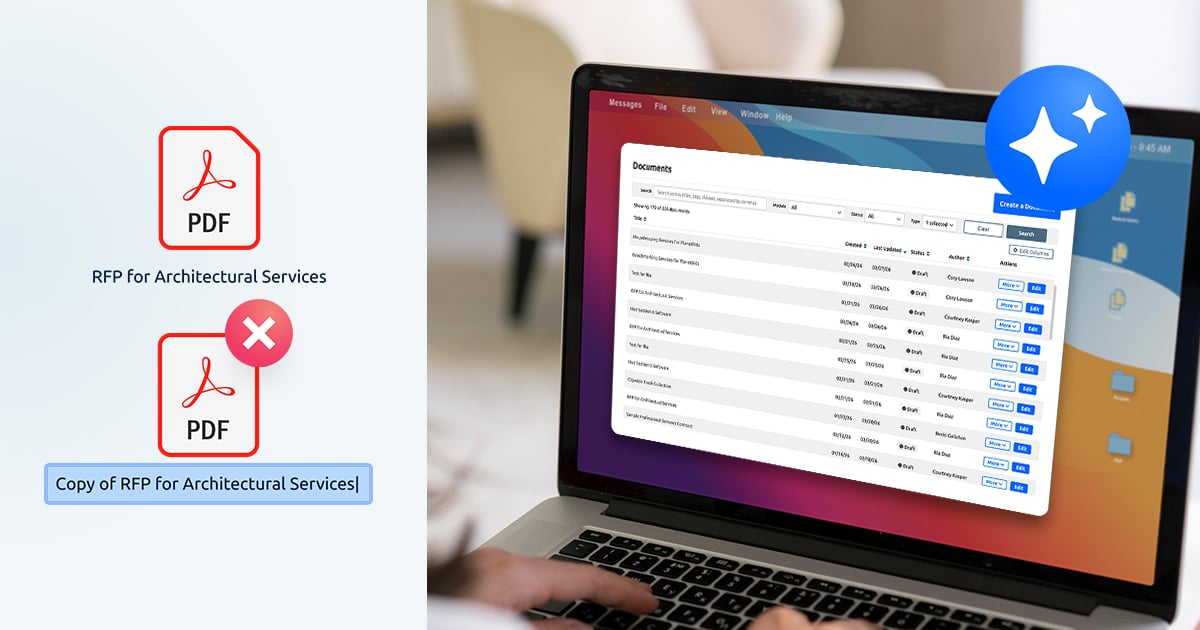
The biggest risk with AI in document creation is fragmentation. If your team is copying content between tools, editing it in different systems, or losing version control, AI can make things harder to manage instead of easing the burden.
So it’s smart to make your AI operate within a broader centralized document management environment that ensures documents are version controlled, edits are tracked, approvals are documented, and final versions are preserved.
AI embedded in an already functional and connected system supports smart processes instead of disrupting them.
Looking for a Document Management system with smart AI functionality?
Check out how PlanetBids Documents helps you clean up draft language, maintain better version control, and ensure only approved language is published.
For agencies just starting to explore AI, document creation is a practical place to begin. It addresses a problem that is repetitive, time-consuming, easy to validate, and low risk by assisting in cleaning up draft language, improving clarity, and standardizing key sections.
You should always keep final review and approval with the buyer and supervisors, and keep everything secure inside your digital procurement system, like PlanetBids, to gain efficiency without losing visibility or control. But better documents will do more than just save you time. They’ll improve your entire process so you can get solicitations out faster, get more competitive and comprehensive responses, and more efficiently utilize public funds.
SHARE


