

The effectiveness of your vendor pool depends on how current, active, and broad it is. A long list of registered vendors may look reassuring, but if it’s outdated, your bid responses will come up short.
The size of your list doesn’t matter as much as the participation rate.
Many agencies don’t have a clear picture of the health of their vendor list until a solicitation reveals a problem, and by then, there’s little you can do. You either accept inadequate competition, rebid and absorb the costs, or move forward with a sole-source award if that’s the only option and deal with the scrutiny that comes with it.
None of those are ideal options, but they’re all largely preventable if you understand where your network stands before the next bid goes out.
What Does a Healthy Pool Look Like?
Healthy doesn’t necessarily mean large. A healthy vendor list is current, well-matched, and actively engaged. Four things determine whether your list is healthy.
Breadth
Do you have enough qualified vendors across the categories you source regularly?
Breadth isn’t about the total registration numbers but about whether there are enough relevant, active vendors in each spend category to generate genuine competition when a solicitation goes out. If you have 500 vendors listed in your network but only 5 in a category that is frequently out for solicitation, you’re likely not getting the competitive pricing that will benefit your agency and your constituents.
Activity
Are the vendors in your pool actually engaging with your solicitations, or scrolling right past them? If a vendor registered two years ago and hasn’t responded to a single notification since then, they’re in your network in paper, not in practice.
Your active vendor count is more useful than your registered vendor count. The important figure is the number of vendors who have submitted a bid at least once in a meaningful timeframe, or who have at least actively engaged by downloading bid documents or submitting questions.
Match
Are vendors registered under the commodity codes that correspond to what your agency buys? Category mismatches mean notifications aren’t relevant to the vendors they’re reaching and that the right vendors aren’t seeing your solicitations at all. If you’re not matching your commodity codes to standards like NIGP or NAICS, you could be eliminating valuable competition.
Currency
Is the contact information in your vendor database updated? Vendors change emails or physical addresses. They merge with other companies or shift the focus of the services they provide. And in some cases, they may leave the market entirely, maybe because they’ve closed down or stopped doing public work.
If you’re not actively maintaining and updating your vendor list regularly, it’s likely full of stale information that is diluting your pool and reducing the reach of every solicitation you send out.
A vendor pool that’s strong in each of these categories will produce consistent competition. But if one area is weak, participation can suffer. Finding the root cause can be difficult.
How to Assess Your Vendor Pool
You already have the data you need, like your solicitation history, vendor registration records, submission logs, and award history. But they can only give you an understanding of your vendor health if they’re organized in a way that is easy to analyze. So, what data should you pull?
Participation Rate by Category
For each of your primary spend categories, calculate the ratio of vendors notified to vendors who interacted or submitted across a specific period, like the last 12 months of solicitations. This is the single most useful number in your assessment.
A participation rate of 30 percent or higher generally indicates a reasonably healthy network. Below 15 percent or anything significantly declining over the last 12 months may indicate that the category needs attention and potential outreach.
If you can’t produce this number quickly by category in just a few minutes, that’s a larger problem to solve, because analysis that takes too long won’t get done consistently.
Single-Bid and No-Bid History
Pull every solicitation from the past 12 or 18 months that received only one or two responses or none at all, and group them by category. If a category appears more than once, you’re spotting a pattern, not a coincidence. Those problem categories are your highest risk and should be prioritized in your vendor development.
Active vs. Registered Vendor Count
Filter your vendor list to those who have submitted at least one bid or quote in the past 24 months (or to those who have interacted with a solicitation by downloading and reviewing, submitting questions, or acknowledging addenda). Subtract that number from your total registered count to understand your dormant vendors. A large dormant population may mean your notifications aren’t reaching an effective audience, that your solicitations are vague or hard to bid on, or that you don’t have the right categories listed to reach the target vendors.
Sole-Source History
List every sole-source award from the past 12 months (or whatever time period you decide) and note which categories or purchase types appear repeatedly. Recurring sole-source awards in the same category are almost always a vendor pool problem, not a genuine market limitation, unless the good or service procured is extremely niche. Sole-source awards are also the clearest early signal that you need to focus development efforts on that specific category before the next solicitation is released.
Category Code Coverage
Analyze whether vendors in your highest-volume spend categories are registered under codes that match your solicitations. For example, if you have a vendor providing IT services, but they’re registered under a general professional services code, they may not be receiving notifications for technology solicitations. Category mismatches are common and one of the most easily corrected causes of low participation.
Warning Signs to Act On Now
Some signals should prompt immediate attention, rather than waiting to work them into a longer general improvement plan.
Single-bid patterns in high-value or high-frequency categories that represent significant spend or regular solicitations should be addressed right away, as your next solicitation in that category is already at risk. If you’re making a specific type of purchase often, take the time now to ensure that bid responses are complete, plentiful, and competitive.
If the same vendor is winning the majority of awards in a category because they’re consistently the only qualified respondent, you’re at risk of an emergency procurement or an overpayment situation at any time. If that vendor decides to up their pricing significantly, is too busy to bid on a project, or exits the market unexpectedly, you’re may find yourself not able to fulfill a requisition or going out for an emergency procurement, which can cost your agency more and set you up for risk.
Haven’t tested your vendor registration process from the vendor’s perspective recently? Do it now. How many steps does it take? Does it have to be done in person or over the phone? What is required before a vendor can receive bid notifications – if they can at all?
In a portal-based procurement system, registration should be straightforward enough that a small business without dedicated business development staff can complete it independently. If it isn’t, or if you don’t have a vendor portal and automatic notification system at all, you’re probably filtering out qualified vendors before they ever see a solicitation.
Finally, vendor databases that aren’t regularly reviewed and cleaned up will leave you wasting time and resources on a reach that isn’t as broad as it looks. Declining participation rates that appear to be a market problem are often a data quality problem in disguise. Delete or reach out to any vendors who registered years ago and still have not engaged or who haven’t responded to any bids in the last year to ensure they’re still actively in business and interested in working with your agency.
Your 90-Day Action Plan
Once you’ve run your assessment, it’s time to fix any gaps that surface. Don’t worry – finding issues is almost certainly likely, but they should be easy to address.
Days 1-30: Identify and Prioritize
Complete the participation rate analysis, single-bid review, and active vendor count assessment described above. Rank categories by risk. Highest spend and criticality combined with lowest participation should get top priority. Focus on the two or three categories where the next thin solicitation is most likely and most consequential.
Days 31-60: Expand Your Pool in Priority Categories
For each high-priority category, identify vendors that are active with other public agencies but not yet registered with yours by polling those other agencies. Also reach out to dormant vendors in these categories to confirm whether they’re still actively seeking government contracts.
Tip: PlanetBids makes outreach and vendor pool expansion easy, by allowing you to access the entire PlanetBids agency network’s list of registered vendors. Simply search by category, region, or certification type and invite those vendors to register with your agency via the PlanetBids portal. They’ll then receive automatic notifications for future relevant solicitations, no manual follow-up required.
Days 61-90: Reduce Friction and Improve
Review your registration process for ease of access. Check the scope and timeline of upcoming solicitations in your priority categories. Is the scope clear enough for a vendor who has never worked with your agency to prepare a competitive response? Is the timeline realistic? Send a non-participation survey to vendors who received notifications on recent solicitations in these categories but either did not interact or did not submit a response. The feedback you get will be the most practical information available for improving participation on the next cycle.
At the end of the 90 days, run your participation rate analysis again for any new solicitations that went out in priority categories during this period. The trend should be moving in the right direction. If it’s not, the non-participation survey responses should tell you why.
Vendor Health is an Ongoing Project
Vendor pools deteriorate naturally, through no fault of the agency, its solicitations, or vendors. Suppliers exit the market, change their service focus, get overwhelmed, update contact information without notifying your agency, or simply stop engaging when notifications stop feeling relevant to their business.
Keeping your vendor network updated and healthy requires regular review, consistent outreach, dedicated follow-up, and treating the vendor database as a living asset rather than a standard list.
If done manually, that administrative work required for that level of consistency can be unsustainable for an understaffed and overworked team. Logging participation, sending notifications, and tracking engagement at the vendor level all take up valuable time that could be spent on more strategic work or just the day-to-day operations of procurement.
Automating these processes with a connected, organized digital procurement system can help you keep vendor lists up to date and free up your team to focus on analysis and decision making, instead of data management.
Ready to do the work?
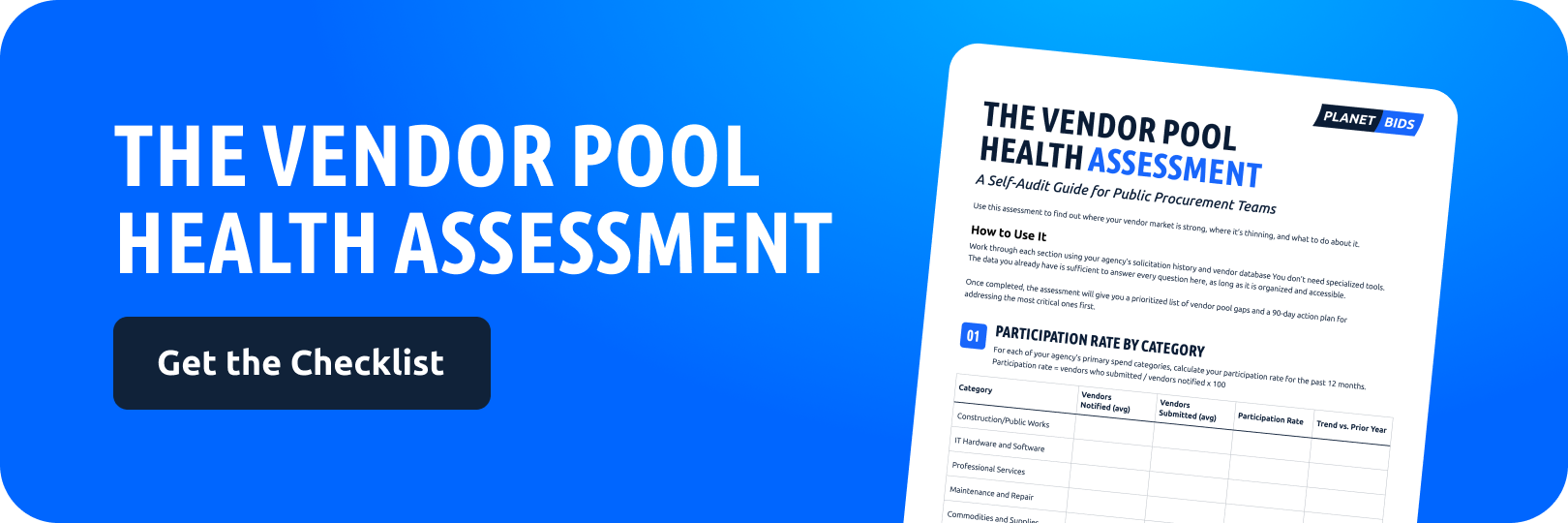
Download the Vendor Pool Health Assessment for the full self-audit framework, including the participation rate worksheet, category risk summary, and 90-day action plan.
SHARE


